
Quick Summary
A 2026 Terrain built with front-wheel drive tows 800 pounds, while all-wheel drive with the factory trailering package raises that to 1,500 pounds across Elevation, AT4 and Denali alike. Trim level changes comfort rather than capability, since every Terrain runs the same 1.5L turbocharged four-cylinder rated at 175 horsepower and 203 pound-feet. Claims of 3,500 pounds circulating online are incorrect for this model year. That 1,500 pound window suits a personal watercraft, a light utility trailer or a teardrop camper, though tongue weight running 10 to 15 percent of trailer weight counts against payload and narrows your usable margin.
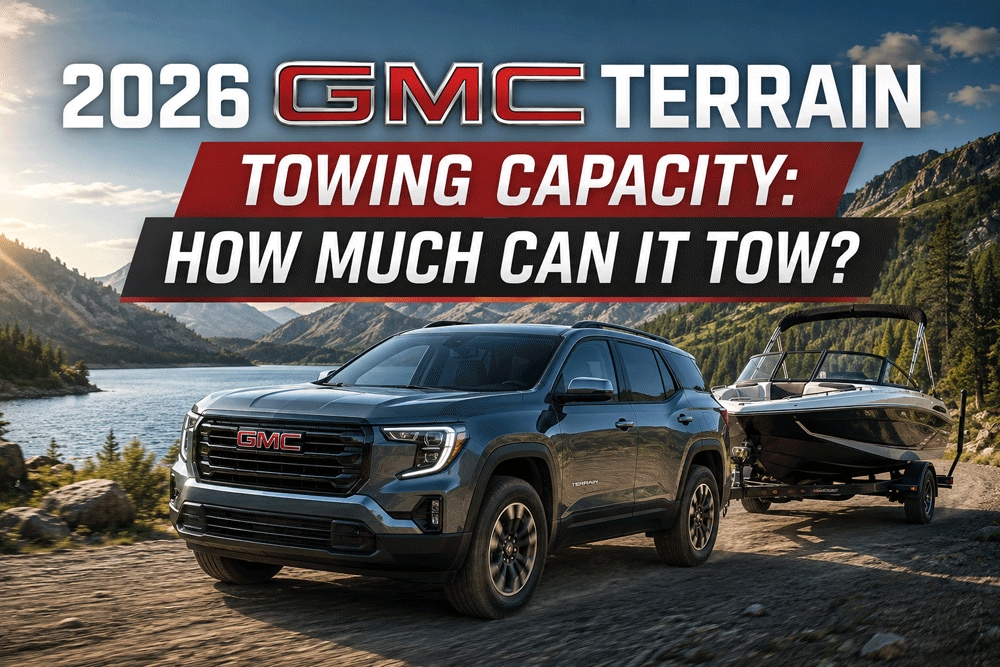
Compact SUVs have grown far more capable over the past ten years, and you may be asking yours to do work that once belonged to a truck. Picture a small utility trailer, a jet ski, or a teardrop camper headed for Greers Ferry on a Friday afternoon. That shift makes the 2026 GMC Terrain towing capacity a fair thing to check before you sign paperwork. The numbers floating around online vary wildly, and some of them are simply wrong. Here is what this compact SUV was truly engineered to pull.
The 2026 Terrain's Official Tow Ratings, Front-Wheel and All-Wheel Drive
The official figures run smaller than much of the internet suggests, and knowing the real ones protects your vehicle and everyone riding in it. A 2026 Terrain built with front-wheel drive carries a maximum trailer rating of just 800 pounds. Step into all-wheel drive with the trailering package and that rating rises to 1,500 pounds, a figure that applies equally across Elevation AWD, AT4 AWD and Denali AWD. Trim level alone changes nothing here, so a Denali badge buys you added comfort and polish rather than extra pulling strength. You may run across articles claiming this compact SUV handles 3,500 pounds, and that figure is incorrect for the 2026 model year. Anyone planning to pull a loaded travel trailer or a heavy fishing boat should be looking at a larger SUV or a pickup instead.
The 1.5L Turbo Engine Behind Those Numbers
Every 2026 Terrain runs the updated 1.5L turbocharged four-cylinder, rated at 175 horsepower and 203 pound-feet of torque. Direct injection and variable valve timing help that small engine pull cleanly at highway speed while holding respectable fuel economy on daily drives. Torque is the figure that governs towing, and 203 pound-feet places this SUV in commuter territory rather than work truck territory. Front-wheel and all-wheel drive versions send that same output through different hardware, which explains the gap between the 800 pound and 1,500 pound ratings. All-wheel drive adds a transfer path to the rear axle along with weight and traction, both of which stabilize a trailer. The engine is capable and honest about what it was designed to do.
What "Properly Equipped" Means and What the Trailering Package Adds
The phrase properly equipped appears in every towing chart, and it carries real meaning. A Terrain reaches its full 1,500-pound rating only with all-wheel drive and the factory trailering equipment already fitted. That equipment centers on a hitch receiver rated for the load along with a wiring harness that powers trailer lights and brake signals. Supporting hardware helps the drivetrain shed heat under load, which protects the transmission on a long grade in July. Aftermarket hitches bolted on later may look identical, though they do not automatically raise a factory rating, and insurance adjusters know the difference. Check the build sheet or window label on any Terrain you are considering, since two similar vehicles can carry different ratings depending on how they were built.
What Fits Inside 1,500 Pounds and What Does Not
Numbers turn useful once you attach them to real cargo sitting in a real driveway. A single personal watercraft on a light aluminum trailer typically lands between 900 and 1,300 pounds fully loaded, which fits comfortably inside the Terrain's window. A small utility trailer carrying mower equipment, brush from a fall cleanup, or a few hundred pounds of feed also works well. Teardrop campers and lightweight pop-ups often weigh 1,000 to 1,400 pounds dry, so they can suit a trip to Greers Ferry or Crowley's Ridge provided you pack with restraint. Where the Terrain runs out of room is the classic family bass boat on a tandem trailer, a loaded 18-foot travel trailer, or a car hauler. Match your actual trailer weight against 1,500 pounds before you commit to anything.
How Payload and Tongue Weight Shrink Your Working Number
Two numbers work against each other every time you hitch up. Payload covers everything the vehicle carries, including passengers, luggage, gear in the cargo area, and the downward pressure a trailer puts on the hitch. That downward pressure is tongue weight, and it usually runs between 10 and 15 percent of loaded trailer weight.
Tongue weight = loaded trailer weight × 0.10 to 0.15
A 1,400-pound teardrop therefore presses roughly 140 to 210 pounds onto your hitch, and every one of those pounds counts against payload. Load four adults and a weekend of luggage on top of that, and your usable margin narrows quickly. Weigh your setup at a certified scale rather than guessing, since guessing is how people discover limits the hard way.
Towing Habits That Keep a Compact SUV Healthy
Staying inside the rating is only the first step, and how you drive determines the rest. Load your trailer with roughly 60 percent of the weight forward of the axle, which keeps sway under control at highway speed. Check tire pressure on both the Terrain and the trailer before every trip, since underinflated tires build heat fast on hot Arkansas pavement. Leave far more following distance than you normally would, given that stopping a loaded rig takes considerably longer than stopping alone. Watch transmission temperature on long climbs and give the drivetrain a rest if the gauge creeps upward. Towing shortens service intervals, so fresh transmission fluid and clean coolant both deserve attention sooner than the standard schedule suggests.
Hook Up with Confidence Instead of Guesswork
Towing well starts with respect for a number rather than resentment of it. The Terrain was built to handle light loads with composure, and staying inside that window keeps your drivetrain healthy for years. Trouble finds drivers who trust a figure they read online over the one printed on their own door jamb, so trust the label.
Our parts department installs factory trailering equipment and can confirm exactly what your Terrain is rated to pull before you hitch anything. Our certified service technicians handle the maintenance that towing demands, including transmission fluid, cooling system work, and fresh tires from our in-house tire inventory. We also offer extended service plan coverage, which gives you a cushion when a vehicle works harder than average.
Schedule your service appointment online or call our Newport service department, and ask us to walk you through your trailering setup. We will make sure it is right before you leave the lot.
FAQs
Can a 2026 GMC Terrain tow a bass boat?
Only a small one. A properly equipped all-wheel-drive Terrain tows 1,500 pounds, which covers a light aluminum jon boat on a single-axle trailer. A typical fiberglass bass boat with motor, fuel and trailer runs well past that figure and calls for a larger SUV or a pickup.
Does the Denali trim tow more than the Elevation?
No. All-wheel-drive Terrains rate at 1,500 pounds regardless of trim, since every one shares the same 1.5L turbocharged engine. Denali buys richer materials, upgraded technology and added comfort rather than pulling strength. Drivetrain and the trailering package determine your rating, not the badge on the tailgate.
What does the factory trailering package include?
A properly rated hitch receiver plus a wiring harness that powers trailer lights and brake signals, along with supporting hardware that helps the drivetrain shed heat under load. That equipment unlocks the full 1,500 pound rating. An aftermarket hitch installed later does not raise a factory rating.
Categories:
Blog