
Quick Summary
The Yukon measures 210.1 inches against the Suburban's 225-plus inches, and that fifteen-inch gap decides cargo room more than anything else. Behind the third row, the Yukon holds 25.5 cubic feet while the Suburban carries 41.5, with maximums of 122.8 and 144.7 cubic feet respectively. Both share the 5.3L V8, 6.2L V8, and 3.0L Duramax paired to a ten-speed automatic, towing 8,400 and 8,300 pounds. The Suburban LS offers a ninth seat and starts near $66,495, while the Yukon counters with a quieter, more refined cabin from around $72,395.
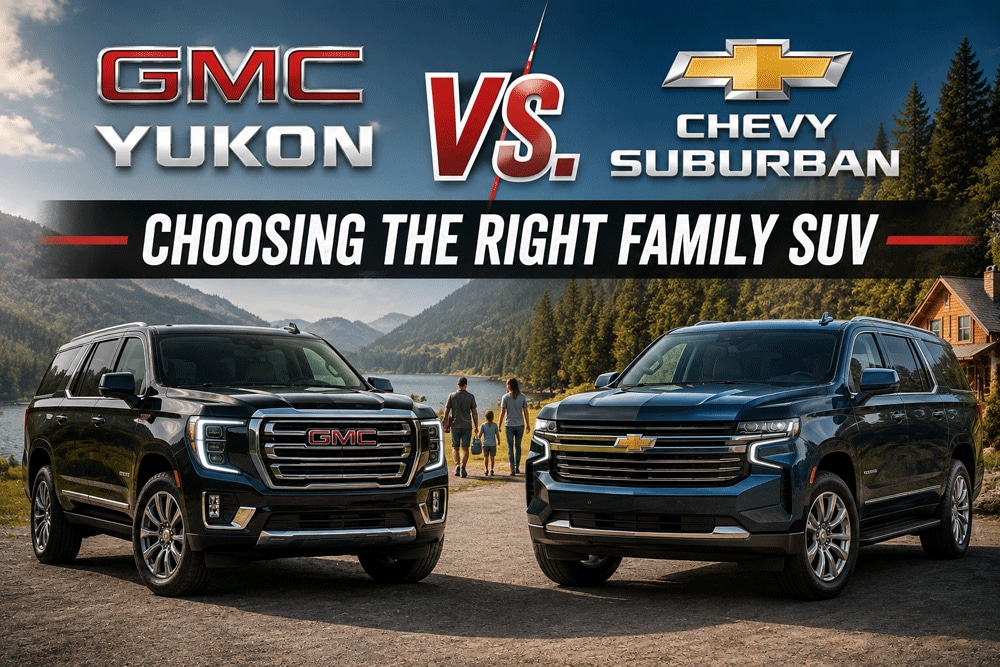
Full-size family SUVs get bought for the moments that stretch a household thin. Think ball tournaments three counties over, a holiday run into Memphis with a cargo box on the roof, or a camper hitched behind you and a load of grandkids. General Motors builds two strong answers, and the GMC Yukon vs. Chevy Suburban debate has split driveways across the Delta. You may assume these two SUVs are one vehicle wearing different badges, and that assumption can cost you real money.
Let's look at where they truly part ways.
Length and Wheelbase: Fifteen Inches That Change Everything
Overall length is the cleanest way to understand what separates these two SUVs. The Yukon measures 210.1 inches from bumper to bumper, while the Suburban stretches past 225 inches on a noticeably longer wheelbase. That gap of roughly fifteen inches decides where each one parks, how each one turns in a church lot, and how comfortably each fits a standard two-car garage. A typical garage bay runs near 240 inches deep, so the Yukon leaves you room to walk around the front and still close the door. The Suburban fits many garages as well, though the margin tightens and a wall-mounted parking guide starts sounding like a smart little purchase. Width and height stay nearly identical between the two, so the difference you feel comes almost entirely down to length.
Cargo Room With All Three Rows in Use
This is where the length gap turns into a daily consequence you can feel. Behind the third row, the Yukon offers 25.5 cubic feet, which handles a grocery run or a few soft bags but fills up quickly with a full house aboard. The Suburban gives you 41.5 cubic feet in that same space, nearly sixteen additional cubic feet of usable room for luggage, coolers, strollers, and ball equipment. Fold the third row and the Yukon opens to 72.5 cubic feet, while dropping both rows brings it to 122.8 cubic feet. The Suburban climbs to a maximum near 144.7 cubic feet with every seat folded flat. If you regularly fill all three rows and still need trunk space, the numbers speak plainly on this one point.
Seating Capacity and Third-Row Comfort
Both SUVs seat a crowd, though the ceilings sit at different heights. The Yukon carries up to eight passengers with a second-row bench, or seven when you choose the available captain's chairs for the middle row. The Suburban matches that and goes one further in its base LS configuration, which offers a ninth seat for households that regularly haul extra kids.
Third-row legroom favors the Suburban by close to two inches, a small figure on paper that adults notice on a four-hour drive to a tournament. Teenagers riding in the back row will feel that difference sooner than anyone else. If your third row mostly stays folded and carries children on short trips, the Yukon seats everyone comfortably without the extra length parked in your driveway.
Engines and Towing: 8,400 Pounds Against 8,300
Under the hood, these two full-size SUVs share far more than they separate. Both offer the 5.3L V8, the available 6.2L V8 rated at 420 horsepower, and the 3.0L Duramax turbo-diesel, each paired with a ten-speed automatic transmission.
A properly equipped Yukon tows up to 8,400 pounds, while a properly equipped Suburban sits right behind at roughly 8,300 pounds. That 100-pound spread comes from calibration and tongue weight management rather than raw strength, and it rarely decides a purchase on its own.
Four-wheel drive versions typically give back around 200 pounds of capacity, since the transfer case and front differential add real weight to the vehicle. Both handle a bass boat, a two-horse trailer, or a mid-size camper down to Memphis without complaint.
Cabin Materials, Quietness and Technology
Sit in both of them, and the difference announces itself within a minute. The Yukon leans premium at entry level, with richer surface materials and more considered trim work across the dash, doors and console. Denali and AT4 versions go further, adding acoustic glass along with extra sound-deadening material in the firewall and floor, which drops highway noise to a genuinely hushed level. The Suburban counters with a larger available touchscreen and a straightforward layout that plenty of drivers prefer for its clarity.
Both ride on independent rear suspension, so the road manners feel much the same over broken county pavement. Choosing here comes down to whether you want the quieter, more polished cabin or the bigger screen and the value that comes with it.
Starting Price and What Each Trim Ladder Buys You
Price separates these two SUVs more clearly than any single spec sheet. A Suburban opens near $66,495, while a comparably equipped Yukon starts around $72,395, a spread of roughly six thousand dollars before options. That money buys the Yukon's upgraded materials, quieter cabin, and the Denali and Denali Ultimate trims sitting at the top of the ladder. The Suburban answers with a broader range of trims at the lower end, which lets you land a large family SUV without stepping into premium territory.
Fuel economy stays close, with the Yukon rated at 16 city and 20 highway against 15 city and 20 highway for the Suburban. Run both payments side by side, then decide whether that refinement premium truly fits your household budget.
The Right Size for the Life You Actually Live
Neither of these SUVs is the wrong answer, and that is what makes the decision feel harder than it should. One asks you to trade parking ease for cargo room. The other asks you to trade cargo room for a tighter turning circle and a quieter cabin. Count how often your third row fills up, and the right choice tends to reveal itself.
We stock both nameplates on the same lot here in Newport, which changes how you shop. You can walk from a Yukon to a Suburban in the same visit, load your own car seats into each third row, and decide with your hands instead of a spreadsheet. We also handle trade appraisals on site and offer extended service plan coverage for families planning to keep an SUV a long while.
Visit us at 3808 South Van Dyke Road in Newport, or give us a call and we will have both parked side by side.
FAQs
Is the GMC Yukon the same size as a Chevy Suburban?
No. The Suburban rides on a longer wheelbase and stretches past 225 inches, while the standard Yukon measures 210.1 inches. The Yukon XL is the true size match, sharing the extended frame and delivering the same 144.7 cubic feet of maximum cargo volume as the Suburban. (50 words)
Which one tows more, the Yukon or the Suburban?
The Yukon edges ahead at 8,400 pounds against roughly 8,300 for the Suburban. That 100 pound spread comes from tongue weight calibration rather than engine strength, since both offer identical powertrains. Expect around 200 pounds less capacity on four-wheel-drive versions of either SUV. (46 words)
Can either SUV seat nine passengers?
Only the Suburban, and only in its base LS configuration with bench seating in all three rows. The Yukon tops out at eight passengers with a second-row bench, dropping to seven when you choose captain's chairs. Third-row legroom also favors the Suburban by nearly two inches.
Categories:
Blog